Venezuela has the world’s largest proven oil reserves, but it can’t solve for the Strait of Hormuz ‘math problem’
As the Iran war drags deeper into its third week, one seemingly obvious solution for more energy is crude oil from Venezuela after the Trump administration seized former leader Nicolás Maduro and pressed for the reopening of the nation’s oil sector.
The glaring problem is more oil from Venezuela—or any other source around the world—represents only metaphorical drops in the global supply bucket compared to the massive losses each day from the Persian Gulf and the effective closure of the Strait of Hormuz by Iran.
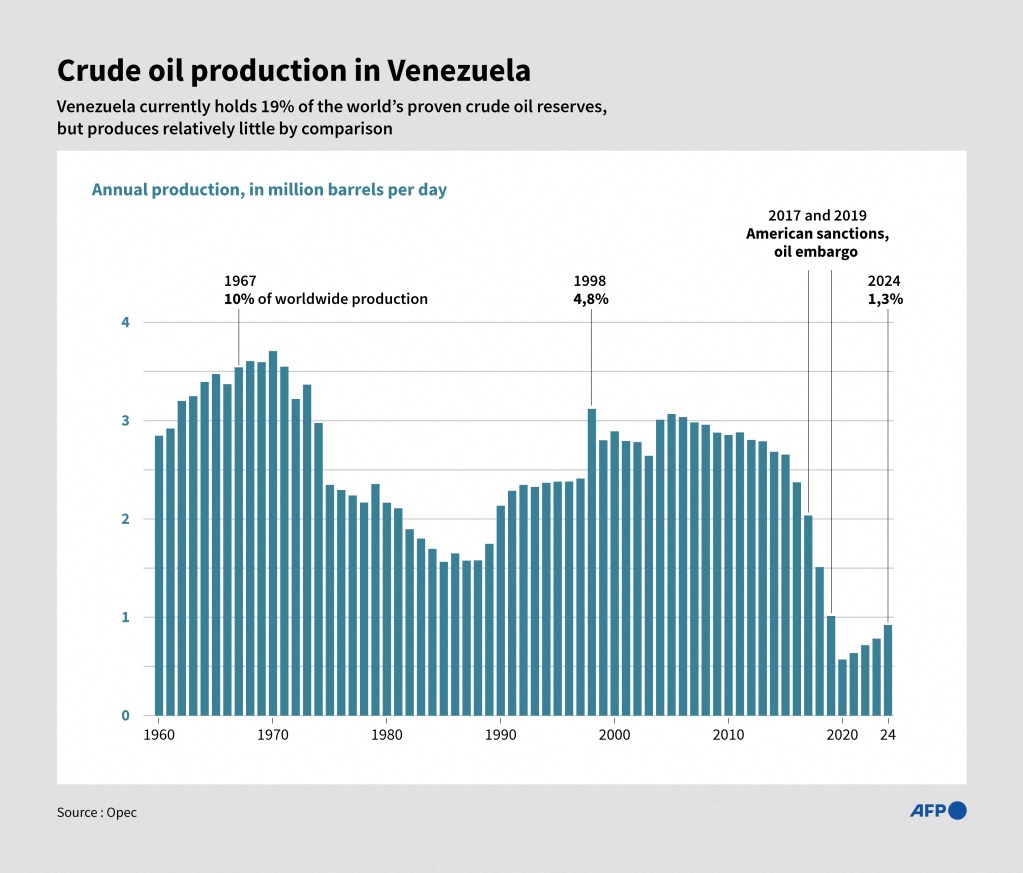
“It’s a math problem,” said Fernando Ferreira, director of the geopolitical risk service at Rapidan Energy Group. “Hormuz flows about 20 million barrels [of oil] a day. Venezuela is currently producing about 1 million [barrels daily].”
The issue is there simply are no alternatives to the de facto closure of the passageway that sees about 20% of the world’s oil and liquefied natural gas trek through it each day.
“Venezuela helps; every little bit helps. But, in the grand scheme of things, it doesn’t change the equation,” Ferreira told Fortune. “There is no medium-term solution other than reopening the straits. Nothing else is going to solve the crisis.”
Arguably the best-case scenario for Venezuelan oil production is it grows from producing nearly 1 million barrels of oil a day late last year to churning out about 1.2 million barrels daily by the end of 2026, said Francisco Monaldi, director of the Latin America Energy Program at Rice University’s Baker Institute for Public Policy.
“I’m expecting less than 250,000 barrels added over the whole year, if at all. That is of course significant for a country that produces just 1 million, but it’s nothing for the world market. It’s less than 0.3%,” Monaldi said, considering the world consumes about 103 million barrels a day. “In particular, it’s very insignificant compared to the disrupted market.”
In the meantime, the White House is aiming to build a coalition of allies to control the strait and escort tankers. The U.S. is also temporarily lifting sanctions on some Russian oil—but that only impacts the destination and prices, not the volumes of oil. And member countries of the International Energy Agency agreed to release a record-high, 400 million barrels of oil from strategic reserves, including 172 million barrels from the U.S.
Pulling that oil from storage will take at least four months however. And while the planned emergency releases are helping keep oil prices from hitting all-time highs, crude oil benchmarks are still hovering near $100 a barrel—up almost 70% from the beginning of the year.
The average price of a gallon of regular unleaded gasoline is $3.80 and rising in the U.S.—up nearly 40% since its January low—but that’s nothing compared to the Asian nations suffering from much higher prices and long lines for fuel, closed schools, and shortened work weeks because of their greater reliance on Middle Eastern oil and Qatari natural gas.
The most successful approach thus far is Saudi Arabia and the United Arab Emirates redirecting as much of their oil flows as they can away from the Strait of Hormuz via the Saudi Arabia East-West Pipeline and the UAE’s Habshan–Fujairah pipeline.
Still, close to 14 million barrels of oil per day remain blocked, according to energy analysts.
“If those pipelines are attacked, then it could be even worse,” Monaldi said.
An Iranian drone attack hit Fujairah on March 16—though not the pipeline itself—triggering the temporary suspension of oil-loading operations.
Positive momentum in Venezuela
Even if Venezuelan supplies won’t help solve the global energy crisis, the country’s oil and gas industry is making notable gains quite quickly, analysts said.
And the growth of oil and gas in South America overall eventually can help the world reduce its reliance on Middle Eastern supplies, Monaldi said.
“In the very long term, it does derisk the oil markets if Venezuela produces much more,” he said, citing other key oil-producing countries. “Venezuela and Brazil and Guyana and Argentina are far away from these geopolitical conflicts.”
Venezuela is still home to the world’s largest proven oil reserves on paper. But the dilapidated industry peaked decades ago with an output of nearly 4 million barrels and needs well more than $100 billion in investments to even approach its past glory. Doing so would take several years to bring to fruition.
“Production is moving up, but it’s moving up gradually. There isn’t a secret pool of oil that Venezuela can tap into and immediately unlock hundreds of thousands of barrels a day,” Ferreira said. “The potential is there, but this is years’ worth of work.”
Momentum is building with Venezuela passing new laws to open the industry to outside investment. Chevron, which was the only U.S. producer that didn’t abandon the country during periods of asset expropriation, has agreed to expand its largest project in Venezuela’s oil-rich Orinoco Belt.
Also, Shell plans to develop gassier regions of Venezuela—both onshore and offshore, which would be closer to Trinidad.
Exxon Mobil plans to send a small team to Venezuela to assess the situation, although CEO Darren Woods drew President Donald Trump’s ire in January when was said Venezuela was currently “uninvestable” until major reforms were enacted.
The ongoing political transition with acting Venezuelan president Delcy Rodriguez is going about as well as it possible could thus far, Ferreira said. Changes should continue and eventually usher in elections.
“Folks that have been to Caracas say it’s open for business,” he said.
This story was originally featured on Fortune.com
from Fortune | FORTUNE https://ift.tt/YzXvkVq
via Financial Mindset

Comments
Post a Comment